Wardogs
 News
WARDOGS HotZone Ep. 2: 185,000 bans, Trust Score and PlaySafe ID
In Episode 2 of The HotZone, BULKHEAD breaks down its 185,000-account ban wave: full-session replays since Season 2, hardware mouse tracking, Ozeti gold-farming raids, hardware and smurf bans, Trust Score with PlaySafe ID, and AI anti-cheat tools.
On this page
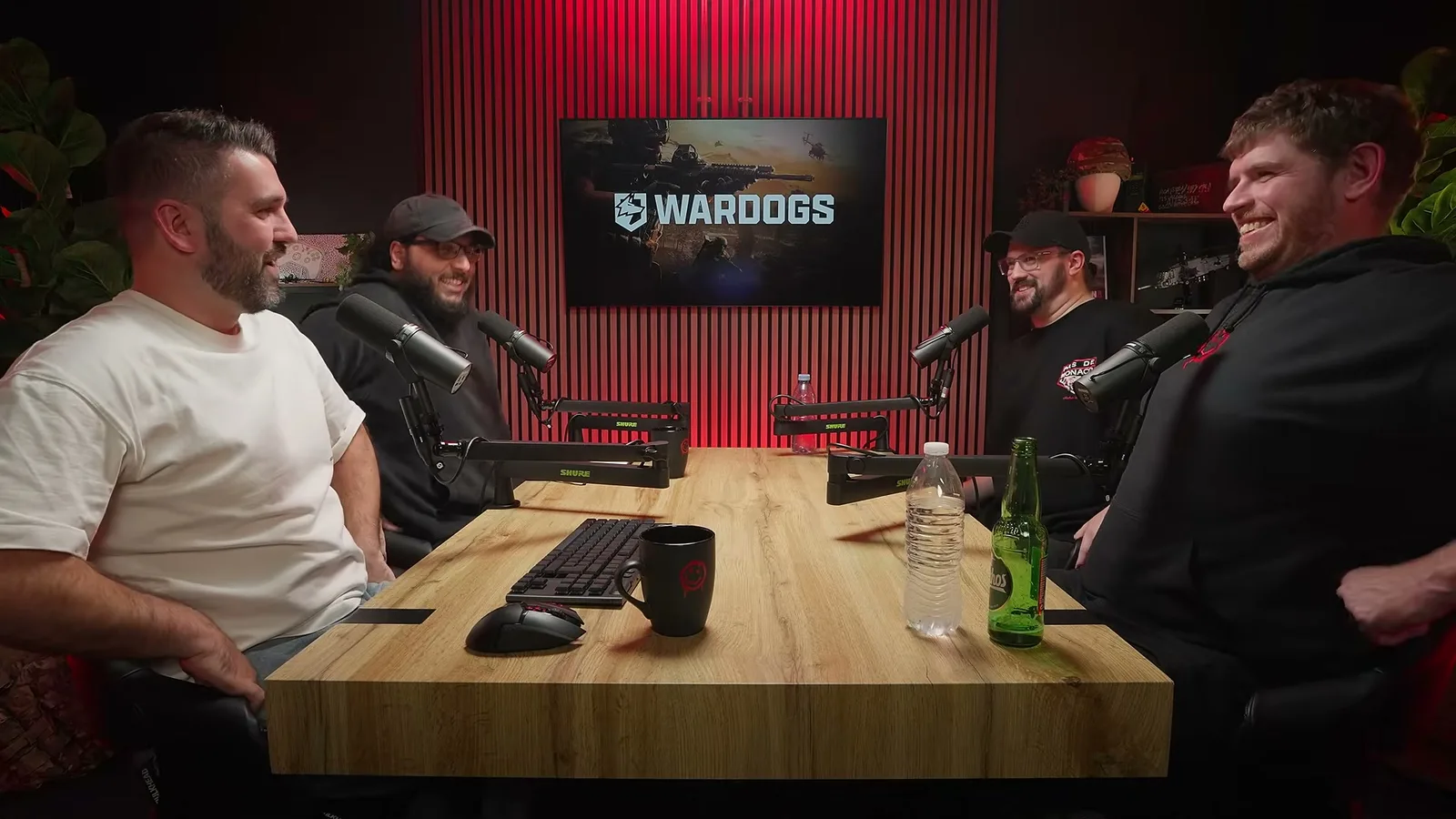
Episode 2 of BULKHEAD's official podcast The HotZone, titled "Anti-Cheat", went out late on 10 November 2026. Executive Producer Joe Brammer, Lead Programmer Lee Taylor, UI/UX Director Howard Philpott and Creative Director Tim Nightingale, who led the live anti-cheat team through launch, recorded the 58-minute conversation right before the Road to Season 03 devlog and the 185,000-account ban wave went live. Following Episode 1 on the Season 2 wipe, the four explain how their replay and telemetry tools work, show a live wipe of a boosting server, and outline Trust Score and PlaySafe ID. The closing card confirms Season 03 launches on 12 November 2026. All figures below are the studio's own.
185,000 bans, session replays and hardware mouse data#
The ban wave removes 185,000+ accounts, close to 5% of the nearly 4 million copies sold in roughly 60 days. Before launch BULKHEAD's best-case forecast was 1 million copies; instead the game hit a peak of 420,000 concurrent players and gathered around 150,000 Steam reviews, meaning the studio banned more accounts than have ever reviewed the game. In Season 1 the team banned only about 10,000 blatant accounts, while firefighting client-side exploits and moving game logic onto the server ate into Season 2 development time.
BULKHEAD works with three main anti-cheat providers, including specialists who left major studios to sell standalone anti-cheat tools. Since the start of Season 2 the team has also used an internal full-session playback tool, jokingly nicknamed "Hilfiger" on the show after Lee Taylor's T-shirt, which lets developers watch back every session of any player across multiple days. Before launching the wave, the team ran simulated bans on batches of 50 flagged accounts and checked their replays by hand until every account in the batch was a confirmed cheater.
Alongside session replays, BULKHEAD overlays hardware-level mouse input onto server hit and kill telemetry to check whether physical mouse movement matches what the client and server recorded. Detection rules sit in the 99.8th to 99.9th percentile, and accounts build up an infraction file across multiple matches rather than catching a ban from a single suspicious play.
Early in Season 1, blatant aimbotters posted 80% headshot rates. As they grew more careful they dialed their cheats down to 60%, 50% and 45%, settling between 24% and 36% across Season 2. Joe Brammer notes that top legitimate FPS streamers such as Shroud sit around 12% in WARDOGS and do not land every full-auto round on the head at 200 metres. In replays, most cheaters no longer snap straight onto character bones; instead they use a "soft lock" within a set distance of a bone, pulling their aim onto the driver of a passing car mid-fight, locking onto players through three buildings, tracking enemies before they crest a hill, or staring into blank walls while reloading instead of checking doorways. Because WARDOGS is a 100-player sandbox where one cheater affects 99 other players, suspects often give themselves away by combining aimbots with mortar cheats or vehicle exploits.
Auto-clickers, macros and false-ban claims#
Tim Nightingale and Joe Brammer state that BULKHEAD does not ban players for plain auto-clickers used to join teams or squads. Even so, they advise legitimate players to turn them off, because macro flags combined with combat use or two or three other suspicious signals add to an account's case file.
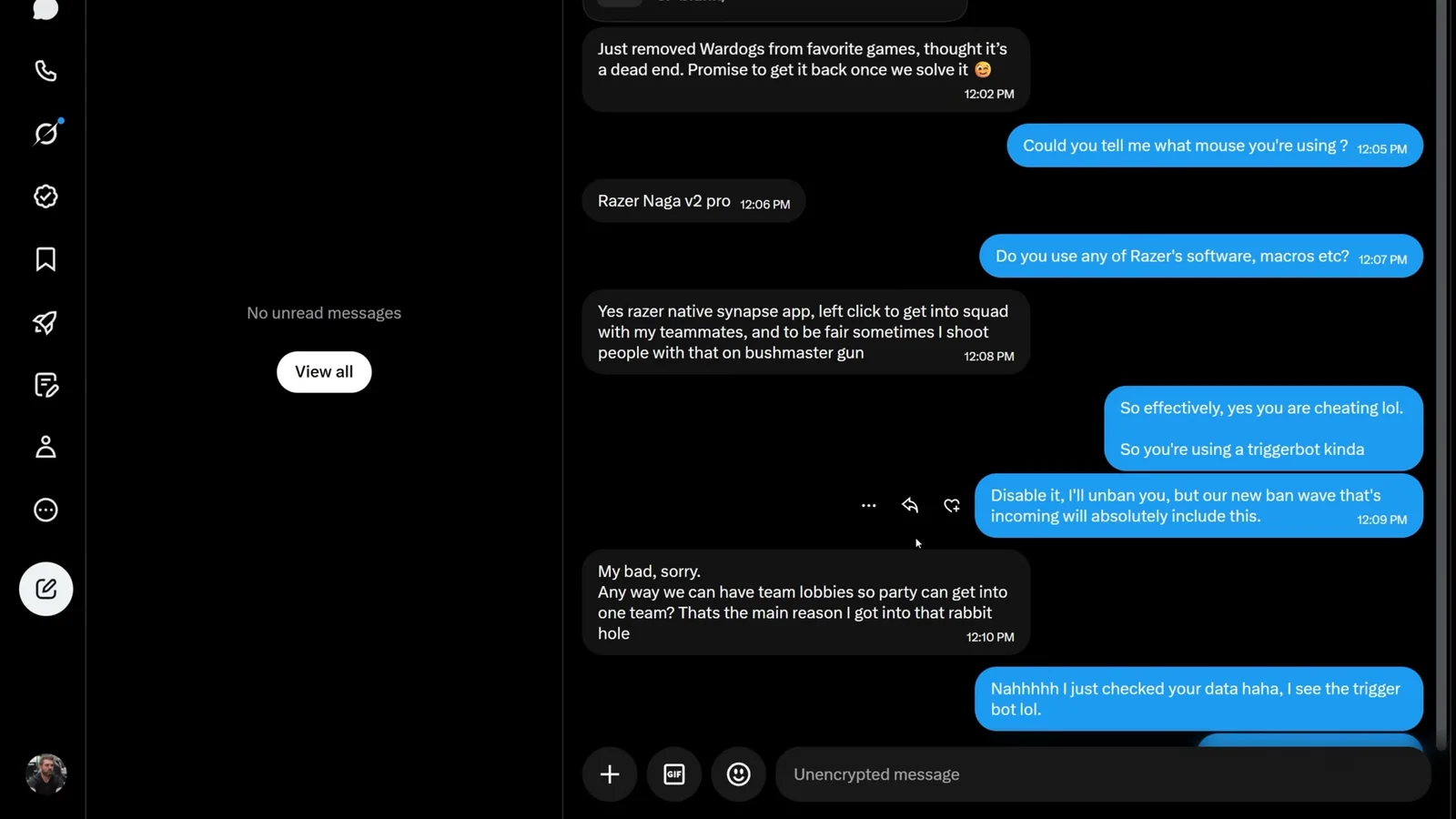
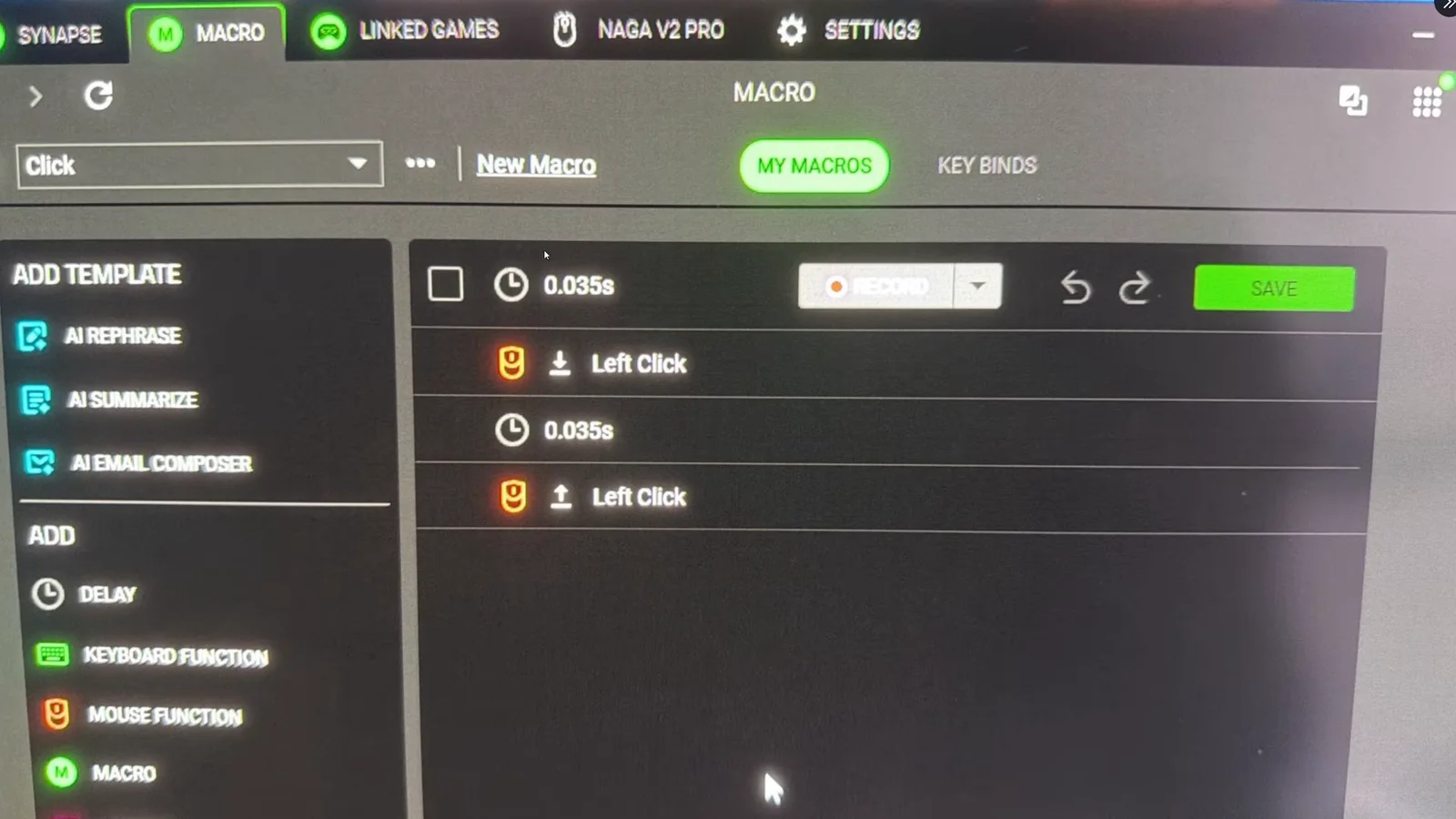
To show how ban appeals play out in practice, Joe shares an X thread and direct messages from a Supporter Edition player with over 400 hours who claimed a false ban and blamed background Unreal Engine builds or a Virpil flight stick. Asked in DMs what mouse and software he ran, the player named a Razer Naga V2 Pro with Razer Synapse for squad clicking and added: "and to be fair sometimes I shoot people with that on bushmaster gun". Joe offered to unban him if he turned it off, checked the account's telemetry and replay data, and replied: "Nahhhhh I just checked your data haha, I see the trigger bot lol." Later the player sent a phone photo of a Razer Synapse Click macro (0.035s left-click loop) as supposed proof, whereas the actual detection was for target-tracking triggerbot behaviour.
Howard Philpott explains why studios rarely answer ban appeals in public: if developers unban one player over a specific story, cheat forums immediately copy that excuse as a template. Lee Taylor adds that real hardware false positives look completely different in the telemetry: on launch day, a batch of factory PCs shared a non-unique network-card ID, and the team spotted and fixed it right away because genuine hardware issues hit whole percentage points of players rather than under 0.5%.
Account patterns, regions and Ozeti gold-farming raids#
Before the wave, Joe Brammer ran an internal "prejudice score" study on the first 10,000 to 20,000 banned accounts (the studio does not ban anyone on it). Between 43% and 46% had never completed Steam's initial profile setup, sitting at Steam level 1 with WARDOGS as their only game. 86% had public Steam profiles, which is Steam's default on fresh throwaway accounts, whereas most legitimate WARDOGS players set their profiles to private.
Regional telemetry also contradicted the claim that most cheaters were in China. Africa (12%) and South America (8%) had the highest share of flagged copies sold, Europe led in total cheaters ahead of Asia, and North America sat lower. Organized XP and gold-bar farming was the one clear regional exception: almost every large farming operation was Chinese-run, often hosted on European servers while legitimate Asian players dealt with DDoS attacks on Asian servers.
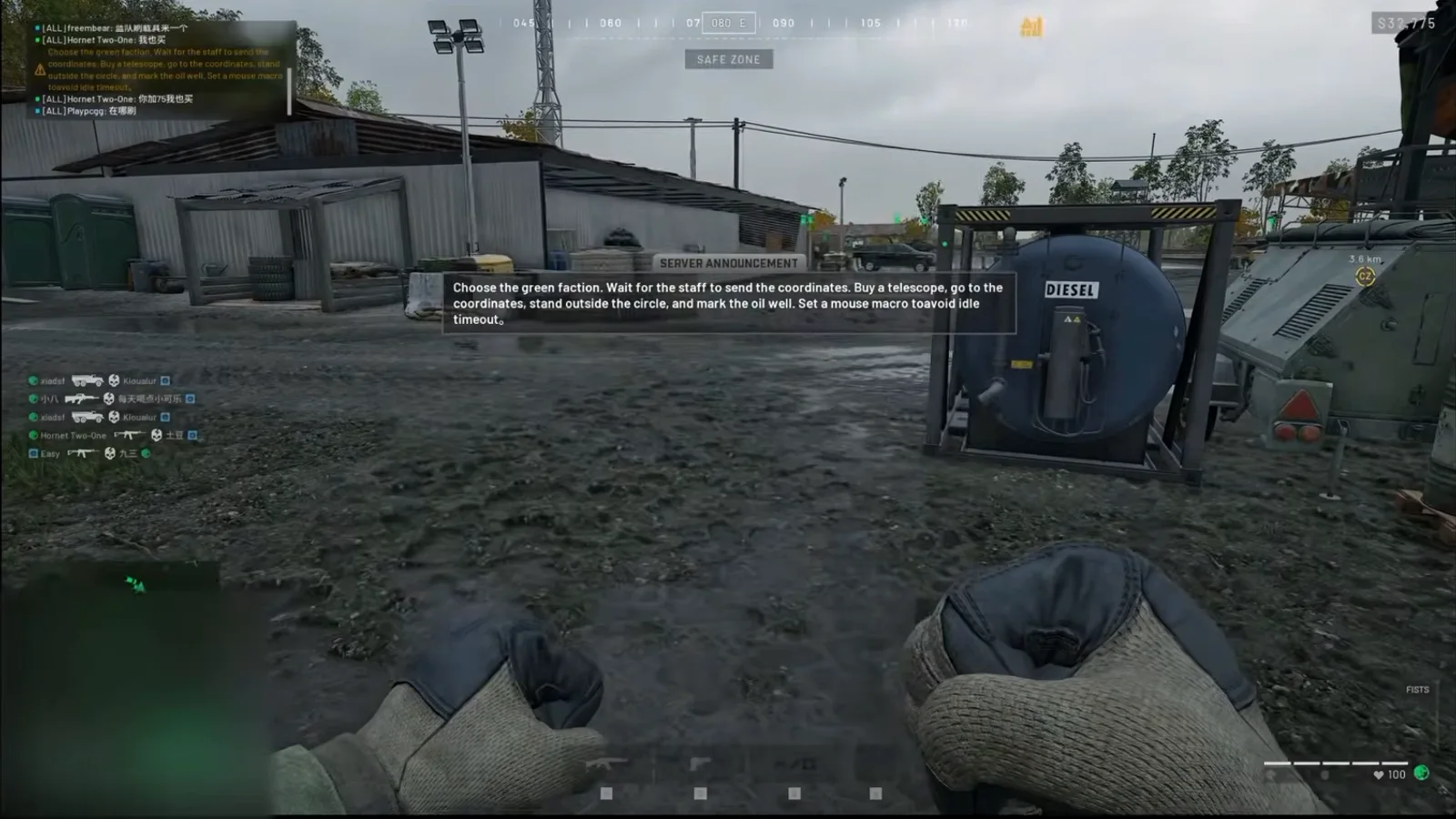
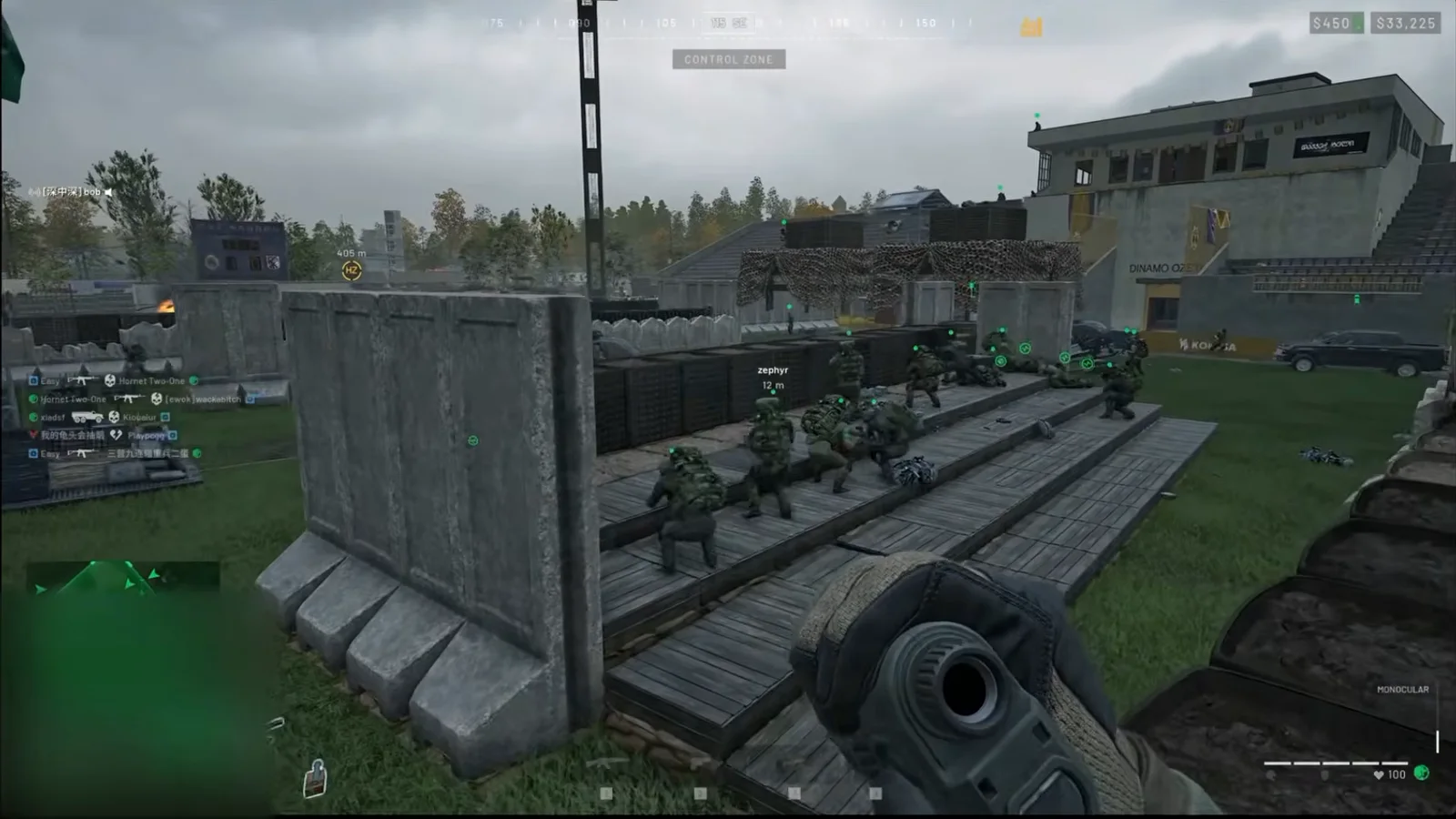
The podcast plays a three-minute recording from a 100-player boosting server on Ozeti. Automated SERVER ANNOUNCEMENT banners policed the lobby: "Non-staff members may only choose the green faction. Do not enter the arena or block others, otherwise you will be removed from the server" and "Choose the green faction. Wait for the staff to send the coordinates. Buy a telescope, go to the coordinates, stand outside the circle, and mark the oil well. Set a mouse macro toavoid idle timeout。" Inside the Dinamo Ozeti stadium, staff built concrete walls and tiered wooden stands on the pitch where green-faction accounts crouched in rows while blue-faction players rotated kills, revives and $100  Monocular spots.
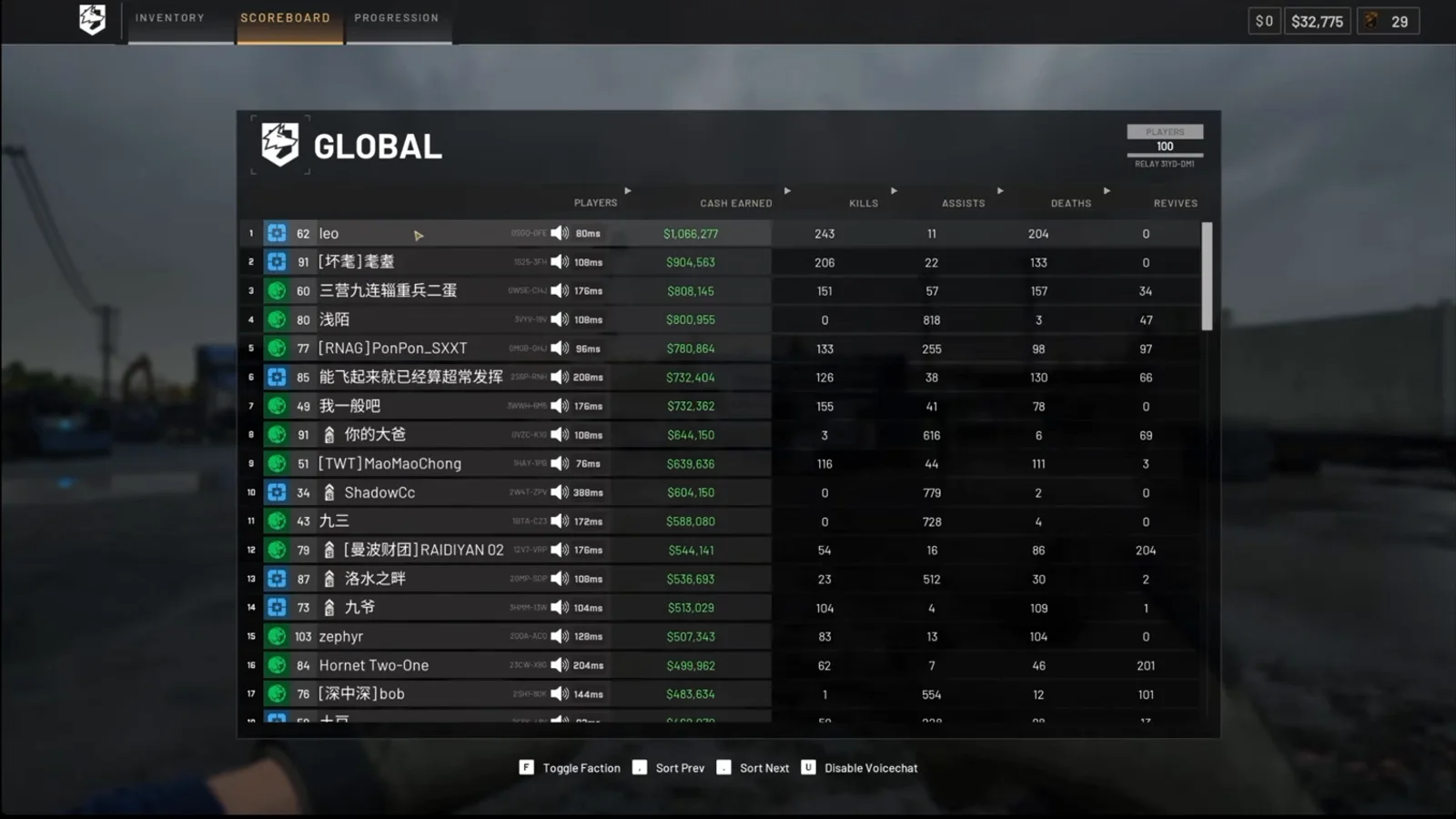
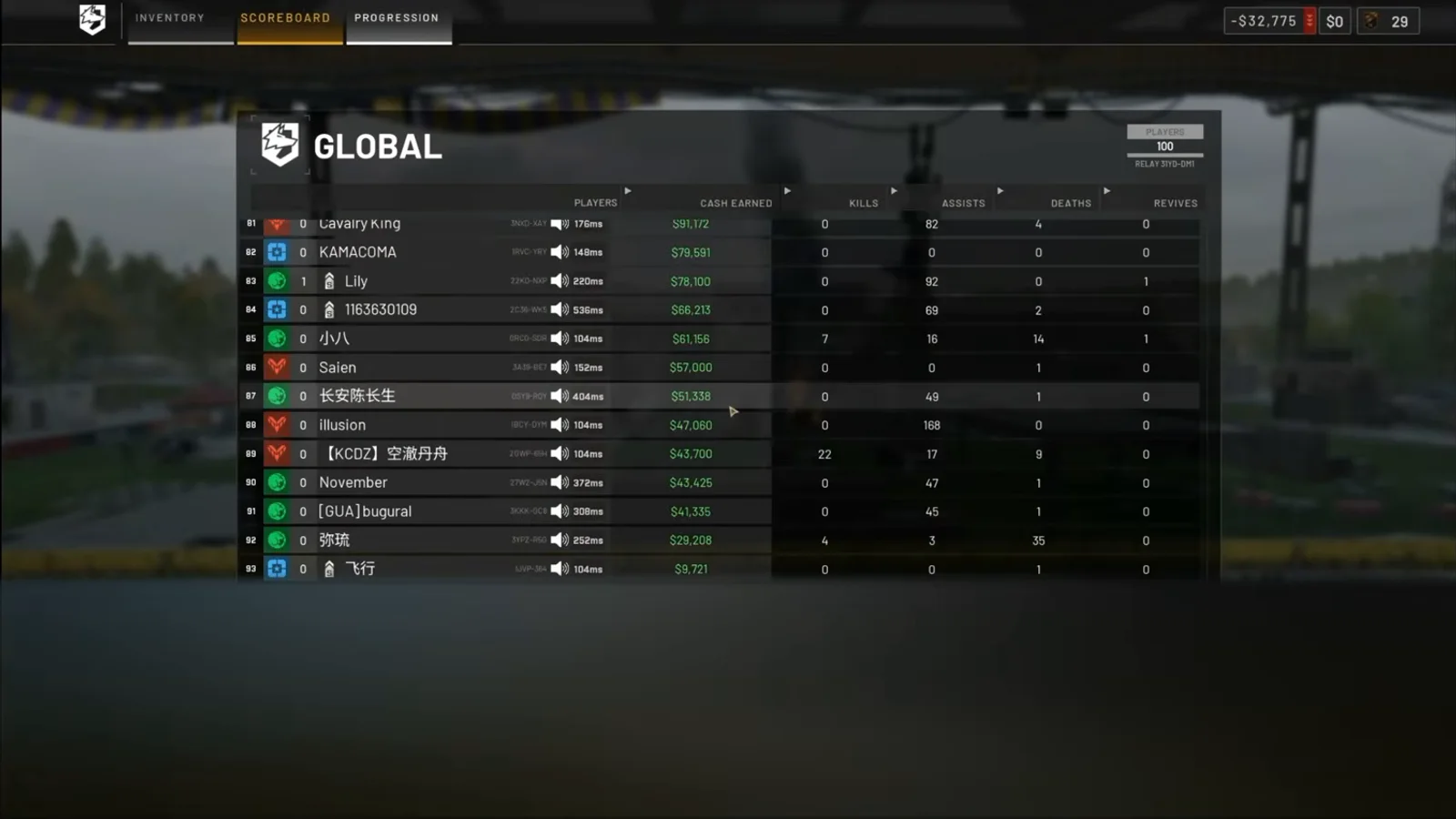
On the GLOBAL scoreboard before the raid, top spot (leo, career level 62) had earned $1,066,277 in that match with 243 kills, fourth place (浅陌, level 80) had $800,955 from 818 assists and zero kills, and further down the board players sat on 835 assists or 373 revives. Joining on Friday nights to test their wipe tools, the developers zeroed out server cash (dropping the HUD balance to -$32,775 and $0), reset every player's career level on the scoreboard to 0 live on screen as chat panicked that the devs had caught them, rolled in rain and fog, force-ended the match at 01:45:46 and banned the lobby. Both farm operators and buyers who paid to join boosting servers receive permanent bans and full resets of cash, unlocks, gold bars and XP.
Smurf accounts, hardware IDs and "digital bloodline" bans#
According to Joe Brammer, cheaters rebuying WARDOGS on fresh accounts have brought in over $1 million, revenue the studio says is not worth keeping. Until now smurf detection only logged linked accounts. Going forward, if a banned player logs a short stretch on a new copy, BULKHEAD matches their hardware ID and bans the new account, and it also traces "up the other way" from a cheating alt back to the user's main account and linked accounts, which the team calls their "digital bloodline".
Because Valve still allows banned accounts to leave Steam reviews, banning 185,000 accounts carries the risk of a review bomb that hurts investment. Joe says owning the company independently let BULKHEAD make a call that risk-averse corporate studios avoid, and asks active players to post an honest Steam review, positive or negative.
Trust Score, hardware security and PlaySafe ID#
Player reports do not trigger automatic bans, but they flag accounts for priority validation. Because new cheats will keep appearing between ban waves, BULKHEAD is turning its internal backend rating into a credit-score-style Trust Score:
- Server thresholds: in Joe Brammer's example, every player starts at 100. Both BULKHEAD and community server admins will be able to set the minimum score required to join a server, creating high-trust, low-trust and no-trust servers where flagged accounts can be sent instead of banned outright.
- PC security boosts: turning on hardware protections raises a player's score (for example to 120). That includes Secure Boot, TPM and the full "golden five" Windows security settings, including the setting that blocks DMA (Direct Memory Access) cards from reading memory externally. Lee Taylor notes that roughly 80% of modern cheats already bypass TPM and Secure Boot on their own, while only 30% to 40% of WARDOGS players currently have the final anti-DMA setting enabled; forcing Valorant-level requirements on everyone tomorrow would lock out 60% of the player base.
- PlaySafe ID: BULKHEAD is evaluating PlaySafe ID, an optional third-party bank-style identity check (KYC). PlaySafe ID verifies the person and passes BULKHEAD only an anonymous token (for example adding 20 points to their Trust Score); the studio never receives personal ID documents.
BULKHEAD stresses it will never force ordinary players to complete KYC checks or mandate TPM and Secure Boot across the whole game, and it ruled out paid subscriptions because they would price out regions such as South America. On the flip side, Lee Taylor notes that when an account is flagged as suspicious, BULKHEAD will be able to require that specific player to enable TPM, Secure Boot and hardware protections to keep playing.
AI in development and the anti-cheat arms race#
At both the start and the end of the podcast, the panel addresses how the 80-to-90-person studio uses AI. BULKHEAD states it does not use generative AI for art, animation or voiceovers. It does use AI heavily in programming, internal tools and anti-cheat machine learning: Lee Taylor says bringing all of WARDOGS' telemetry streams and review dashboards together after Season 1 would previously have taken a team of six engineers a full year.
Joe Brammer and Lee Taylor argue that while Steam's AI disclosure badge prompts some players to dismiss games as "AI slop", cheat writers face zero moderation and openly paste game data into frontier models on cheat forums to generate aimbots, angle projections and mortar calculators. Using AI on the defensive side, they say, lets a mid-sized independent team run large-scale live infrastructure without over-hiring and laying staff off at Christmas.
Source: THE HOTZONE | EP2 | "Anti Cheat" on the BULKHEAD YouTube channel.